
正义的伙伴
How technology boosts Beijing's air pollution governance_我的网站

一 | (新加坡讯)新加坡内政部展开公众谘询,邀请公众对拟议中的《防诈骗保障法案》提出意见。这个法案将针对正蒙受诈骗却不肯相信当局的受害者,以授权警方暂时限制受害者的银行户头交易。
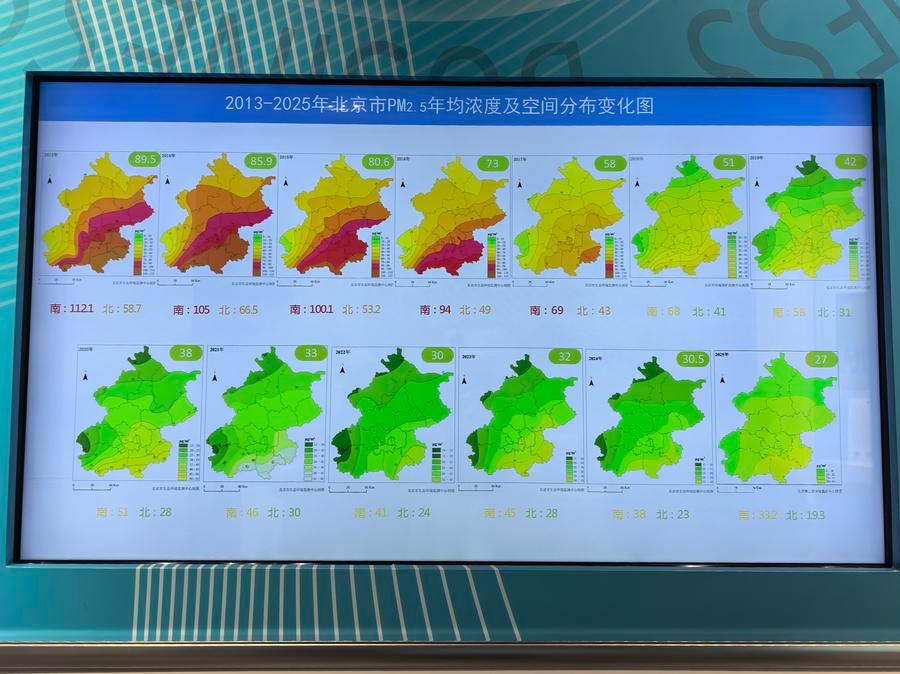
In 2025, Beijing recorded 311 days with good air quality and only one heavily polluted day, compared with 58 heavily polluted days in 2013, when the city officially began releasing PM2.5 monitoring data. The annual average PM2.5 concentration, a key indicator of air quality, fell from 89.5 micrograms per cubic meter in 2013 to 27 micrograms per cubic meter in 2025, a decline of nearly 70 percent.
The progress has drawn international attention. The United Nations Environment Programme has highlighted Beijing's experience in improving air quality as a model for other cities.
According to experts at the Beijing Municipal Ecological and Environmental Monitoring Center, the cleaner air is the result of a comprehensive system integrating environmental monitoring, scientific analysis, policymaking, regional cooperation and law enforcement -- with digital technologies now woven into every link of that chain.
MORE TARGETED APPROACH
Effective governance begins with accurate monitoring. Beijing has established a multi-level air-quality monitoring network. Figures show 35 standard monitoring stations across the city continuously measure six major pollutants, while more than 1,000 compact sensors deployed across communities and townships provide more detailed information on local air-quality variations.
The monitoring system was gradually built by the Beijing Municipal Ecological and Environmental Monitoring Center, one of China's earliest ecological and environmental monitoring institutions, responsible for monitoring Beijing's air, water, noise, soil environments and ecosystems.
The center has developed an analytical system that can identify around 125 components of PM2.5, covering most of its composition and helping researchers trace pollution sources.
"Source analysis helps us identify the major contributors to pollution at different stages, providing a scientific basis for policymakers to target key emission sources," said Li Yunting, technical director at the center.
Coordinated by the Beijing Municipal Ecology and Environment Bureau, the center has conducted four rounds of PM2.5 source analysis studies with other institutions, with results released in 2014, 2018, 2021 and 2025.
The latest analysis showed that regional transport contributed 57 percent of Beijing's PM2.5 pollution. Among local sources that accounted for the remaining 43 percent, vehicle emissions and residential sources represented the largest share of pollution, a distinctive characteristic of a major international metropolis.
The monitoring results have provided scientific support for a series of pollution-control measures. For example, Beijing has promoted new-energy vehicles to reduce transport emissions and adopted advanced techniques, including air-supported membrane structures, to control dust emissions. Meanwhile, coal combustion pollution, once a major contributor, has almost been eliminated and is no longer listed among the main sources, reflecting broader national efforts to reduce coal consumption, promote clean energy and upgrade heavily polluting industries.
With PM2.5 concentrations now at relatively low levels, further gains in air quality will depend on more targeted, science-driven approaches.
SMARTER ENVIRONMENTAL GOVERNANCE
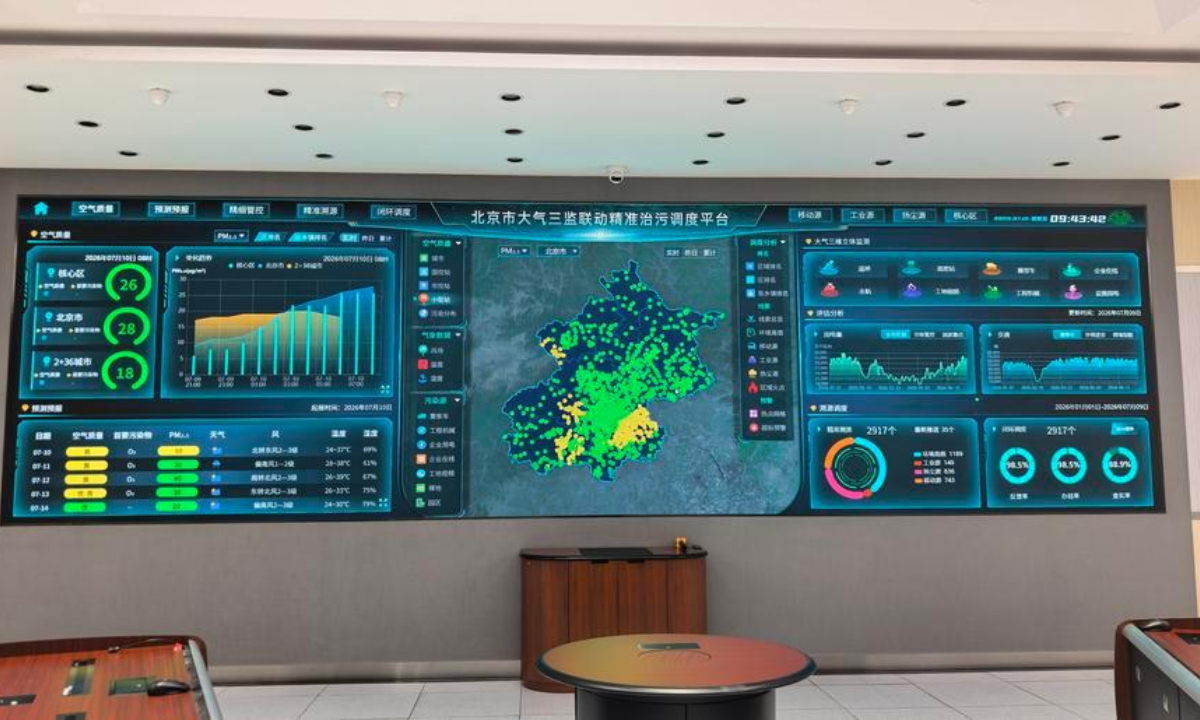
Beyond monitoring pollution, Beijing has built a data-driven environmental governance system that links monitoring, regulation and enforcement in a closed loop from detection to action and follow-up evaluation.
Developed by the center and known as the innovative regulation-monitoring-inspection linkage model, the system integrates artificial intelligence, the Internet of Things, satellite remote sensing and vehicle-mounted monitoring technologies to pull together environmental data from multiple sources onto a unified platform.
"The system brings information that was once scattered across different departments onto a single platform," said Zhang Likun, director of the smart system division at the center, adding that this enables off-site enforcement and joint cross-sector actions involving housing, water resources and transportation, significantly improving the efficiency and precision of environmental management.
Using more than 30 intelligent algorithms, the platform automatically analyzes data and identifies potential pollution risks, based on which monitoring staff identify the most pressing problems and forward them to enforcement departments.
The approach has already drawn international attention. Clean Air Asia, an international nongovernmental organization focused on improving air quality across Asia, featured the system as a representative case study in its "China Air 2025" report. The model was also presented at the 2026 Better Air Quality Conference and recognized with the Certificate for Clean Air Best Practice Sharing.
China has integrated ecological conservation into its modernization drive. As the country speeds up efforts under the Beautiful China Initiative, Beijing's experience demonstrates how technology can support more precise, coordinated and sustainable environmental governance.
。新加坡内政部昨日发文告指出,当局将在未来几个月推出《防诈骗保障法案》(Protection from Scams Bill),法案将允许警方在有理由相信受害者会向诈骗团伙汇款时,向银行发出限制令(Restriction Orders,简称RO),限制受害者在一段时间内不能进行银行交易。新加坡警察部队8月22日公布2024年上半年诈骗和网络犯罪数据时指出,警方在这期间接获2万8751起这类罪案通报,诈骗案占了92.5%,达2万6587起,涉及金额达3亿8560万新元。新加坡警察部队公布今年上半年诈骗和网络犯罪数据时指出,警方在这期间接获2万8751起这类罪案通报,诈骗案占了92.5%,达2万6587起,涉及金额达3亿8560万新元。其中,多达86%的骗案是受害者自行转交钱财,并非由骗子操控受害者的户头转账。这类受害者心理已被攻陷和操控,无法相信自己受骗。《联合早报》报导,新加坡内政部《防诈骗保障法案》的重点包括:限制令仅针对骗子没有实际接触受害者,而是采用数码或电讯网络(如电话、短信或线上通讯)进行的诈骗案。

二 | 限制令将限制受害人的户头,通过线上银行、手机银行和柜台向外转账。不过,受害人可以向警方申请取出用于合法用途的款项(如维持日常生活、支付账单等)。限制令包括所有信用相关业务,包括信用卡交易,个人贷款,以避免骗子说服受害者代为申请信用额度或贷款。限制令为期28天,这让警方有较充裕时间说服受害者,相信他正在受骗。28天后,警方将再次评估受害者是否有被骗风险,若有则可更新限制令;每次更新有效期仍是28天。新加坡警方将只对7家国内系统重要性银行(Domestic Systematically Important Banks,简称D-SIB)发出限制令。

三 | 这7家银行是星展银行、大华银行、华侨银行、汇丰银行、马来亚银行、渣打银行及花旗银行。

四 | 新加坡内政部强调,发出限制令是迫不得已的防范诈骗手段。警方在有理由相信某人正成为诈骗犯的目标,并在可预见的未来向诈骗团伙转账,同时在其他说服受害者的选项已经用尽,而且未奏效的情况下,才会发出限制令。受害者可针对警方发出的限制令向内政部上诉,内政部将保有最后决定权。

五 | 在新加坡的公众谘询将在9月30日截止,可上https://go.gov.sg/feedbackscamsbill或民情联系组(REACH)网站,查阅公众谘询文件。
Current article:http://7l28k4d.tourunbiaodubaicubangninan.shop/news/20260826_77088.html
Published on:12:44:05
我的网站最近更新
- 外网球迷吐槽贝林厄姆:比佩德里差远了,他掌握了找存在感的艺术
- 遭压制,火箭半场仅得34分,本赛季赛季最低得分
- 省自然资源厅技术人员到旧门满族乡监测信息
- "보완수사권 작동 중 발생" 선부터 그은 與…野 "수사권 실험 중단해야"
- Chinese, Belarusian airborne troops launch Swift Eagle drill
- 辽宁振兴大讲堂暨抚顺振兴讲坛开讲
- 印度谈中印实力:两国实力对等,印度空军优于中国空军,再战必胜,吃瓜玩游戏,原创 印度谈中印实力:两国实力对等,印度空军优于中国空军,再战必胜
- Jennifer Lawrence and Josh Hutcherson to return in Hunger Games: Sunrise on the Reaping
- 夏天就这么过去了?1月底天气多变,2月初气温将陡降
- Chicago and police union reach tentative deal on 20% raise for officers
- PM to inaugurate Kisan Samman Sammelan on Monday
- 走在乡间小路上丨这里有个“围裙村”
- 国足零封世界杯参赛队!
- French rider Valentin Debise’s Chongqing 'Landing Visa' ride puts mountain city in global spotlight
- 中方强调对话谈判是乌克兰问题唯一可行出路
- 【“十五五”开局看河北】外贸“量稳质升” 开放型经济活力迸发
- 大力优化营商环境 加快高质量发展|复勘审核“云上办” 企业办事“零跑腿”
- 火花終止連敗有曙「光」
- 最高检:依法严惩通过虚假诉讼等方式骗取套取养老保险金行为
- 장동혁, '당원주권 2.0' 선언…"당협위원장 직선제로 당원 참여, 모든 보수 결집"
- 夢想吉「星」高照
- 习近平为约旦国王阿卜杜拉二世举行欢迎仪式
- 美术里的援宁故事
- 售39.69万起 新款沃尔沃XC60价格公布 插混版将于6月26日上市
我的网站热门资讯
- 《剑星》续作要变味?13年老兵加盟团队却引发玩家焦虑
- 孙颖莎因伤退出WTT欧洲大满贯
- 谁还记得他?四年前击杀阿根廷的沙特英雄,本届世界杯却引发争议
- 北京自19-20赛季后首次晋级四强,与山西时隔13年再约半决赛
- 晒卤肉饭照片被发现盗图后陈时中道歉,网友:这人有什么是真的?_阿贵_脸书
- 青年深夜砍人夺枪交火,警察2死1伤,7人被拘,1人为新加坡籍!
- 自然资源“一张图”建设扎实推进 推动跨部门跨层级数据共享共用
- China's pharmaceutical industry sees accelerated innovation breakthroughs in H1
- 金价暴涨,老庙黄金“玩不起”?订单拦截、拒发货引众怒
- 浦发银行被罚近千万元,涉违规办理期权交易等
- 时评 | 把产业优势转化为县域消费优势
- 博伦智汇宣布完成千万级天使轮融资
- 三折以上的“代打电话”网上汽车预约?小成本背后的大风险
- 哈尔科夫失利,泽连斯基将责任推给全世界:各个国家都要为此负责
- 中国人寿保险(集团)公司原董事长王滨被逮捕 曾被指“制造、放大金融风险”_中国人寿原董事长王滨被逮捕_违纪
- 峰值推力35.2吨自研发动机同步研发!上海集中全力:C929研制等
- 全面建设现代化沿海经济强市|科技创新 产业向“新”
- 泽连斯基拒绝选举:这会摧毁乌克兰,知世,原创 泽连斯基拒绝选举:这会摧毁乌克兰
- 这个奥克兰日长周末,来自澳大利亚的飓风将影响北岛的天气
- 2026融资融券利率多少?两融利息计算、市场行情与下调方法
- Nominations for 69th Sobha Filmfare Awards South 2024 (Kannada) are out!
- 宇树科技连跌5日 股价跌破600元 市值较历史高点蒸发2000亿元
- 华硕ROG XBOX掌机X 20周年版发布:首发7.4英寸星云原画屏、升级TMR摇杆
- 中信证券:公募低配待扩容,万亿打新成常态